
This article contains affiliate links. If you buy through our links, we may earn a commission at no extra cost to you. Our assessments are anchored strictly in industrial performance standards like ANSI/BIFMA.
The modern professional spends a significant portion of their life in a seated position. Achieving optimal wellness and long-term physical health requires more than just a standard office chair; it demands an intentional approach to ergonomic seating and advanced posture engineering. By evaluating the intersection of human anatomy, material science, and mechanical design, workspaces can be transformed into high-performance environments that eliminate structural body strain.
Looking to optimize your seating setup immediately?
Compare Top-Rated Ergonomic Chairs on Amazon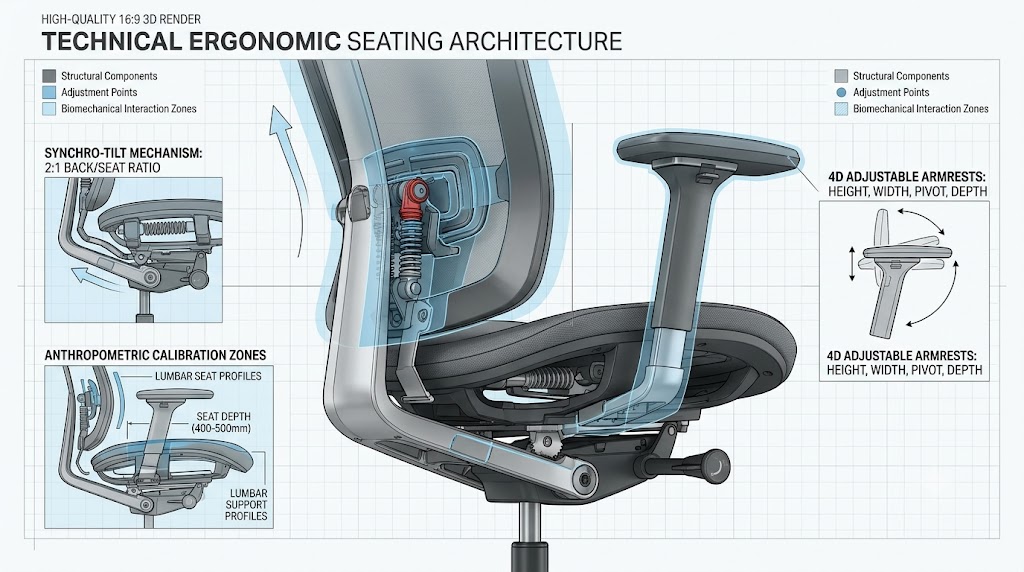
Key Takeaways
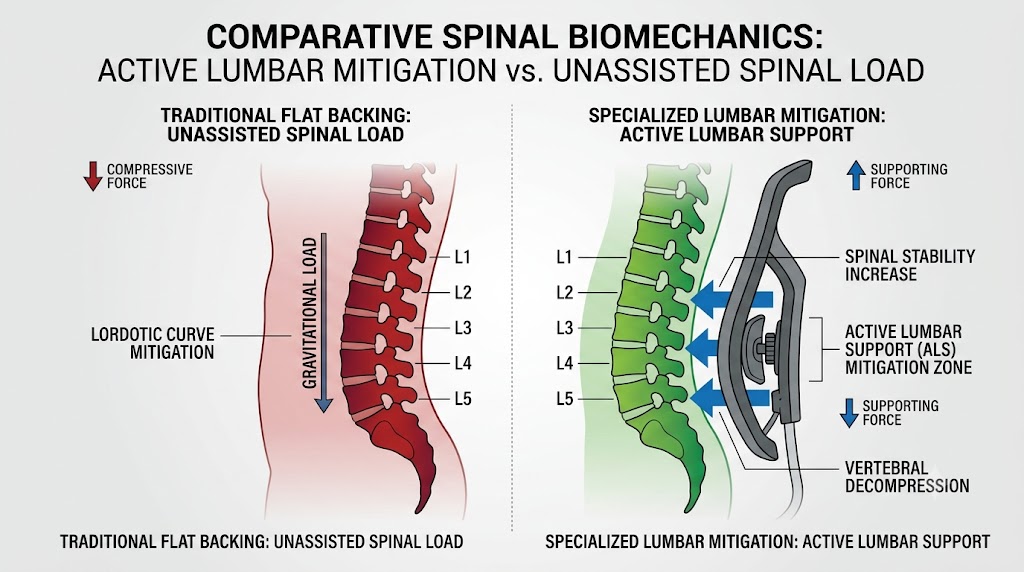
- Lordosis Alignment: Active lumbar mitigation prevents the flattening of the natural lower spinal curve.
- Dynamic Mechanics: Synchro-tilt mechanisms maintain healthy trunk-to-thigh ratios compared to standard tilt setups.
- Anthropometric Calibration: Proper seat pan depth must avoid direct pressure on the sensitive popliteal fossa.
Strategic Buying Instruments for Ergonomic Seating
Selecting a high-tier structural seating solution requires an understanding of how raw mechanical features translate directly to physical support. The market features everything from entry-level office task chairs to highly advanced, responsive posture platforms that actively dynamically adjust to micro-movements.
When evaluating options, enterprise procurement and remote professionals must prioritize structural durability metrics alongside orthopedic alignment features. Industry standards like the ANSI/BIFMA X5.1 certification serve as the foundational benchmark for assessing safety, sustainability, and structural performance.
Premium Posture Platform
Engineered to satisfy rigorous orthopedic requirements while meeting comprehensive industrial durability matrices.
- Best For: Continuous high-occupancy 8-hour shift support.
- Key Advantage: Active lumbar mitigation with full synchro-tilt linkage.
- Certification: Full ANSI/BIFMA X5.1 Compliance.
Intensive Shift Support & High-Durability Architecture
For environments demanding continuous focus over extended timelines, standard seating options quickly break down, causing tracking issues for the spine. True task chairs engineered for extended use rely on heavy-duty gas cylinders, reinforced nylon or aluminum frames, and high-density molded foam structures that resist sagging over thousands of compression cycles.
If you are sourcing long-term support platforms for your workspace, exploring curated industrial deep dives on high-durability chairs for 8-hour shifts provides targeted, stress-tested hardware recommendations tailored to high-occupancy use.
Spinal Biomechanics & Lordosis Curve Alignment
The cornerstone of any premium office seating layout is targeted lumbar mitigation. The human lower spine features a natural inward curvature known as the lordosis curve. Without active structural counterpressure, extended sitting causes this curve to flatten, increasing intervertebral disc pressure and accelerating muscular fatigue.
| Mechanical Feature | Target Anatomical Region | Biomechanical Objective | Action Link |
|---|---|---|---|
| Dynamic Lumbar Support | Lumbar Spine ($L1-L5$) | Maintains the natural lordosis curve and minimizes disc compression under load. | Compare Options |
| Synchro-Tilt Mechanism | Hip & Pelvic Girdle | Maintains a healthy torso-to-thigh angle to promote fluid motion during recline. | Compare Options |
| 4D Armrests | Cervical Spine & Shoulder Girdle | Alleviates structural stress on the trapezius muscle group to prevent neck strain. | Compare Options |
Implementing advanced lumbar support engineering ensures that the user's weight is balanced evenly across the seating matrix, rather than concentrating harmful pressure points on the lower spine.
Biomechanical Adjustments & Dynamic Mechanism Control
A premium chair is useless if it cannot be configured to the unique physical dimensions of the individual. True posture engineering relies on an adaptable ecosystem of moving components designed to scale across different body shapes.
Anthropometric Calibration & Popliteal Clearance
Anthropometric calibration is the precise process of mapping seating hardware dimensions directly to human physical measurements. A critical adjustment parameter here is seat pan depth.
- The Problem: If a seat pan is too deep, it presses directly against the sensitive area behind the knees, known anatomically as the popliteal fossa, cutting off circulation.
- The Solution: If the seat pan is too shallow, it fails to support the thighs adequately, shifting an excessive amount of weight onto the lower hips.
- The Rule of Thumb: A properly calibrated seat depth leaves a gap of roughly two to three fingers between the front edge of the seat pad and the back of the user's knee.
Nerve Decompression & Pelvic Tilt Optimization
Maximizing physical comfort over long periods requires constant micro-adjustments to facilitate deep nerve decompression. When sitting, the body’s weight should rest primarily on the hard bones of the lower pelvis, known as the ischial tuberosities (commonly called the sit bones).
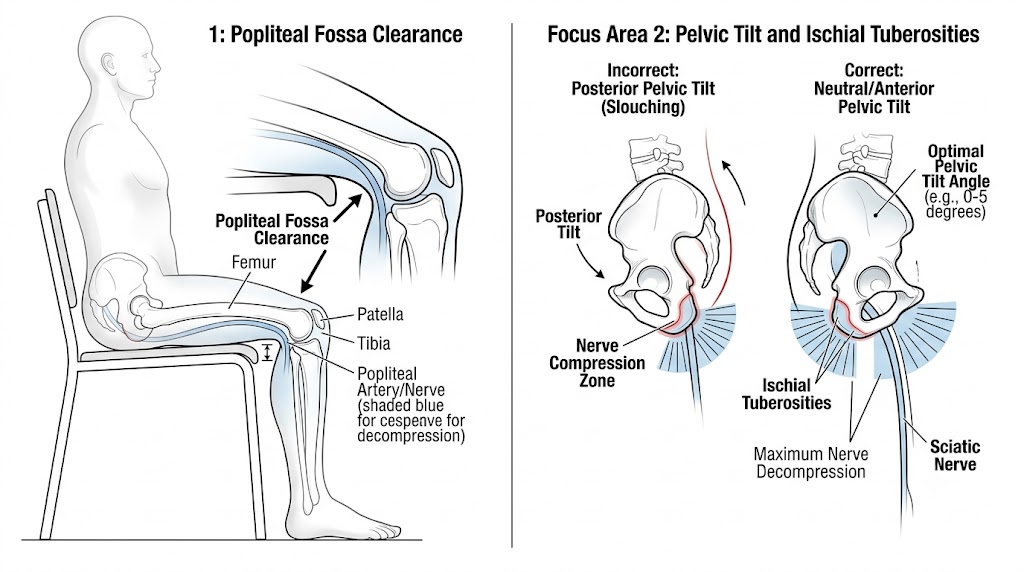
These premium seating platforms utilize an active pelvic tilt design to gently rotate the pelvis forward, which naturally aligns the rest of the spine above it. Pairing this with synchronized back-and-seat movement paths keeps the body active and moving, preventing painful fluid retention and reducing overall musculoskeletal strain. For those struggling with localized lower back tension, reviewing specialized anatomical pain mitigation options can reveal highly effective alternative seating structures.
Upgrade Your Workspace Ergonomics
Protect your spinal health, maintain your lordosis curve, and maximize focus with hardware verified against professional biomechanical metrics.
View Professional Seating Options on AmazonFrequently Asked Questions: Structural Seating Engineering
What makes a synchro-tilt mechanism different from standard tilting systems?
A standard tilt mechanism tilts the backrest and the seat pan at the same angle, lifting your knees up and putting pressure on your thighs. A synchro-tilt mechanism reclines the backrest at a faster ratio than the seat pan (typically 2:1). This keeps your feet flat on the floor and maintains proper alignment, promoting regular movement without throwing off your visual field or posture.
How do 4D armrests protect against upper body strain?
Standard armrests only adjust up and down, which can leave your shoulders shrugged or your elbows unsupported. 4D armrests move in four distinct directions: up/down, forward/backward, wide/narrow, and pivot inward/outward. This complete range allows you to position the padding directly under your elbows, reducing strain on your neck and shoulders.
Why is ANSI/BIFMA X5.1 compliance important when choosing an office chair?
The ANSI/BIFMA X5.1 standard is a strict set of safety and performance guidelines developed by the American National Standards Institute and the Business and Institutional Furniture Manufacturers Association. A chair that passes this certification has been put through thousands of intense stress, impact, and drop tests, ensuring it will remain safe and stable through years of daily use.
How does improper seat pan depth contribute to poor leg circulation?
When a seat pan is too deep, users are forced to slide forward to avoid pain behind their knees in the popliteal fossa area. Sliding forward pulls the lower back away from the lumbar support, causing slouched posture. At the same time, the hard front edge of the seat presses against local blood vessels, reducing blood flow to the lower legs.